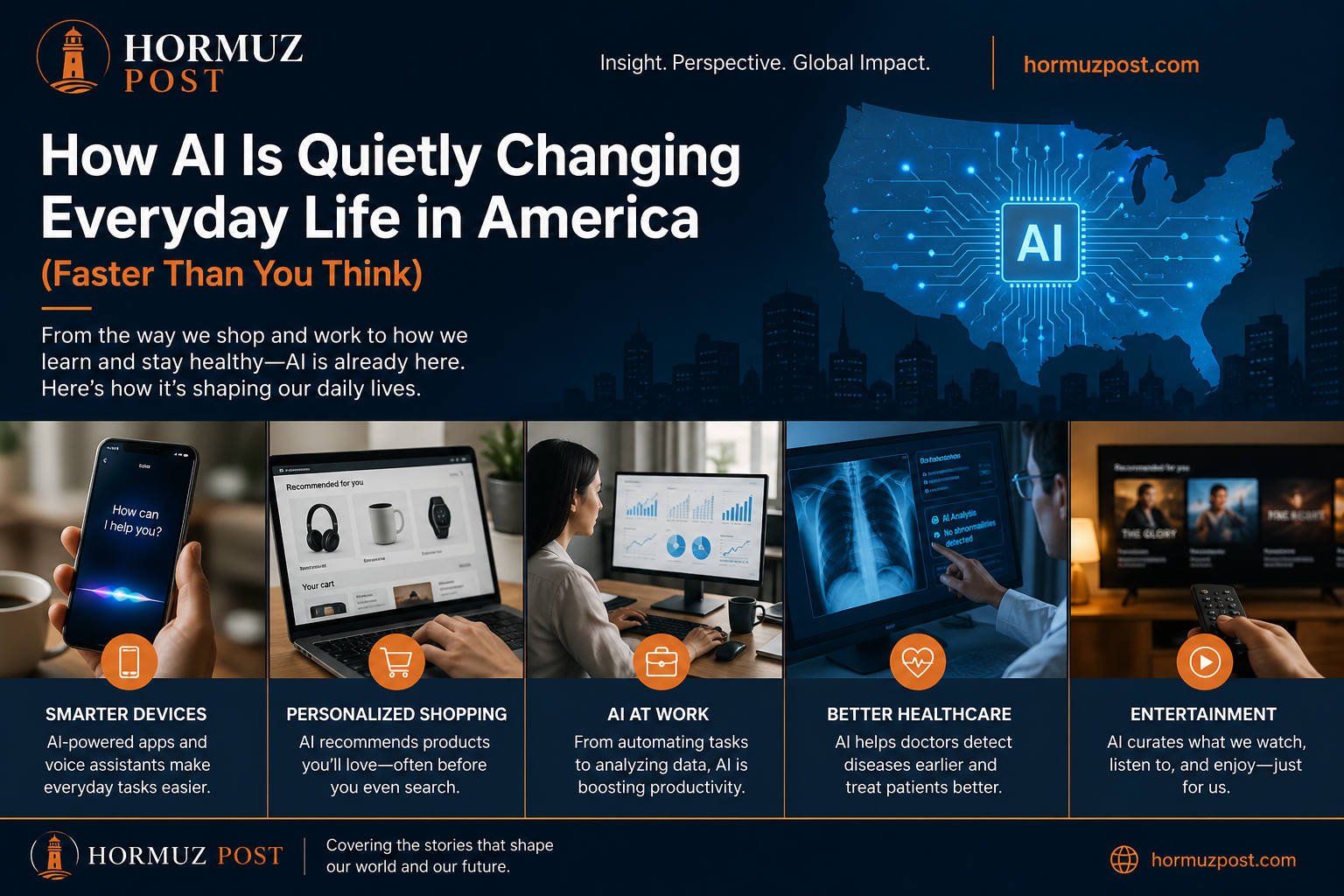
Introduction: The AI Revolution You Barely Notice
Artificial intelligence (AI) is often portrayed as something futuristic—robots, self-aware machines, or dramatic technological takeovers. But the reality is far less dramatic and far more impactful. AI is already deeply embedded in everyday life across the United States, quietly shaping how people live, work, shop, and interact with the world.
What makes AI so powerful isn’t just its capability—it’s its invisibility. Unlike past technological revolutions, AI doesn’t always announce itself. It operates behind the scenes, learning from behavior, making predictions, and influencing decisions in ways most people rarely notice.
From the moment Americans wake up and check their phones to the time they unwind with a streaming service at night, AI is constantly at work. This silent integration is what makes AI one of the most transformative forces of the modern era.
AI in Smartphones: The Invisible Assistant You Rely On
For most Americans, the first interaction of the day is with a smartphone—and that interaction is powered by AI.
Predictive text suggests what you’re about to type. Voice assistants answer questions, set reminders, and control smart home devices. Notifications are prioritized based on what apps think you care about most. Even your photos are automatically organized using facial recognition and pattern detection.
Navigation apps analyze traffic patterns in real time, helping users avoid congestion and reach destinations faster. Music and podcast platforms study listening habits to recommend content tailored to individual tastes.
These features are so seamlessly integrated that they feel natural. But behind every suggestion is a complex system analyzing data, learning patterns, and improving over time.
The result? A digital assistant that becomes more useful the more you use it.
AI in Online Shopping: Redefining Consumer Behavior
Online shopping in America has evolved into a highly personalized experience, largely driven by artificial intelligence.
When users browse an e-commerce platform, they are not seeing a neutral marketplace. Instead, they are interacting with a curated environment shaped by algorithms. These systems analyze browsing history, past purchases, time spent viewing products, and even what similar users are doing.
This leads to highly targeted recommendations that often feel surprisingly accurate. Many consumers have experienced the moment of seeing a product suggestion that perfectly matches something they were just thinking about.
AI also influences pricing, search results, and even the order in which products are displayed. Retailers use machine learning to predict demand, optimize inventory, and improve customer satisfaction.
In this sense, AI is not just responding to consumer behavior—it is actively shaping it.
AI in the Workplace: A Silent Shift in How America Works
Artificial intelligence is transforming the American workplace, but not always in obvious ways.
Rather than replacing jobs outright, AI is often integrated into existing workflows. It automates repetitive tasks, analyzes large datasets, and assists in decision-making processes. This allows workers to focus on more strategic and creative responsibilities.
For example, AI tools can draft emails, summarize reports, generate content ideas, and provide insights from complex data in seconds. In industries like finance, marketing, and logistics, AI has become an essential tool for efficiency.
However, this transformation is not without challenges. As AI takes over routine tasks, the skills required in the workforce are shifting. Adaptability, creativity, and digital literacy are becoming increasingly important.
There is also growing concern about job displacement. While AI creates new opportunities, it may also render certain roles obsolete. The future of work in America will likely depend on how quickly workers and institutions can adapt to these changes.
AI in Healthcare: A New Era of Precision and Speed
One of the most promising applications of AI is in healthcare. Across the United States, hospitals and medical institutions are using AI to improve diagnosis, treatment, and patient care.
AI systems can analyze medical images—such as X-rays, MRIs, and CT scans—with remarkable accuracy. In some cases, these systems can detect patterns that are difficult for human eyes to identify, leading to earlier diagnoses of conditions like cancer.
Predictive analytics is another powerful tool. By analyzing patient data, AI can identify individuals at risk of certain diseases, allowing for preventative measures to be taken before symptoms even appear.
AI is also helping streamline administrative tasks, reducing the burden on healthcare professionals and allowing them to spend more time with patients.
While AI is not replacing doctors, it is enhancing their capabilities. The combination of human expertise and machine precision has the potential to significantly improve healthcare outcomes.
AI in Entertainment: Personalized Content Consumption
Entertainment in America has become more personalized than ever, thanks to AI.
Streaming platforms use sophisticated algorithms to recommend movies, TV shows, and music based on user preferences. These recommendations are not random—they are carefully calculated using viewing history, ratings, and even the time of day content is consumed.
This level of personalization keeps users engaged and often leads to longer viewing sessions. It also influences cultural trends, as certain shows or songs gain popularity through algorithmic promotion.
Social media platforms operate in a similar way. The content users see is curated based on their interactions, interests, and behavior. This creates a highly individualized experience, where no two users see the exact same feed.
While this personalization enhances convenience, it also raises questions about echo chambers and the influence of algorithms on public opinion.
AI in Transportation: Smarter and Safer Mobility
AI is also transforming how Americans move from place to place.
Navigation systems provide real-time updates on traffic, accidents, and road conditions. Ride-sharing services use AI to match drivers with passengers efficiently, reducing wait times and optimizing routes.
Autonomous vehicle technology is advancing rapidly, with companies testing self-driving cars across the country. While fully autonomous transportation is not yet widespread, the foundation is already being built.
AI is also improving safety. Advanced driver-assistance systems (ADAS) can detect potential hazards, assist with braking, and even prevent collisions.
These innovations are making transportation more efficient, convenient, and, potentially, safer.
Smart Homes: AI Where You Live
AI is increasingly present in American homes, turning everyday living spaces into smart environments.
Devices like smart speakers, thermostats, and security systems learn user preferences and adapt accordingly. Lights can adjust automatically based on time of day, thermostats can optimize temperature for comfort and energy efficiency, and security cameras can distinguish between familiar faces and strangers.
This level of automation adds convenience, but it also changes how people interact with their living spaces. Homes are no longer passive environments—they are responsive systems that anticipate needs.
The Privacy Trade-Off: Convenience Comes at a Cost
As AI becomes more integrated into daily life, concerns about privacy and data security are growing.
The effectiveness of AI depends on data—lots of it. Every recommendation, prediction, and automated decision is based on information collected from users.
This raises important questions:
- How much data is being collected?
- Who has access to it?
- How is it being used?
Many Americans are becoming more aware of these issues and are demanding greater transparency and control over their data.
Balancing the benefits of AI with the need for privacy is one of the biggest challenges facing the technology today.
The Economic Impact: AI and the Future of the U.S. Economy
AI is not just changing individual lives—it is reshaping the broader U.S. economy.
Businesses that adopt AI technologies often gain a competitive advantage through increased efficiency and innovation. This can lead to economic growth, new industries, and job creation.
At the same time, the transition may create disruptions. Certain sectors may experience job losses, while others see rapid expansion.
Government policies, education systems, and corporate strategies will play a crucial role in determining how these changes unfold.
What the Future Holds: An AI-Driven Society
The role of AI in everyday life is only expected to grow. Emerging technologies such as advanced robotics, natural language processing, and machine vision will further integrate AI into society.
Future developments may include:
- Fully autonomous transportation systems
- AI-powered education tailored to individual learning styles
- More advanced healthcare diagnostics and treatments
- Smart cities optimized for efficiency and sustainability
As AI becomes more advanced, it will also become less visible—blending seamlessly into the fabric of daily life.
A Quiet Transformation with Massive Impact
Artificial intelligence is not a distant possibility—it is a present reality. It is already shaping how Americans live, work, and interact with the world in ways both subtle and profound.
What makes AI unique is not just its power, but its quiet presence. It doesn’t demand attention, yet it influences decisions, behaviors, and outcomes every day.
For individuals, businesses, and policymakers, understanding this transformation is essential. The more we recognize how AI is shaping our lives, the better prepared we will be to navigate its opportunities and challenges.
The future of AI in America is not something to wait for—it’s something we are already living.

