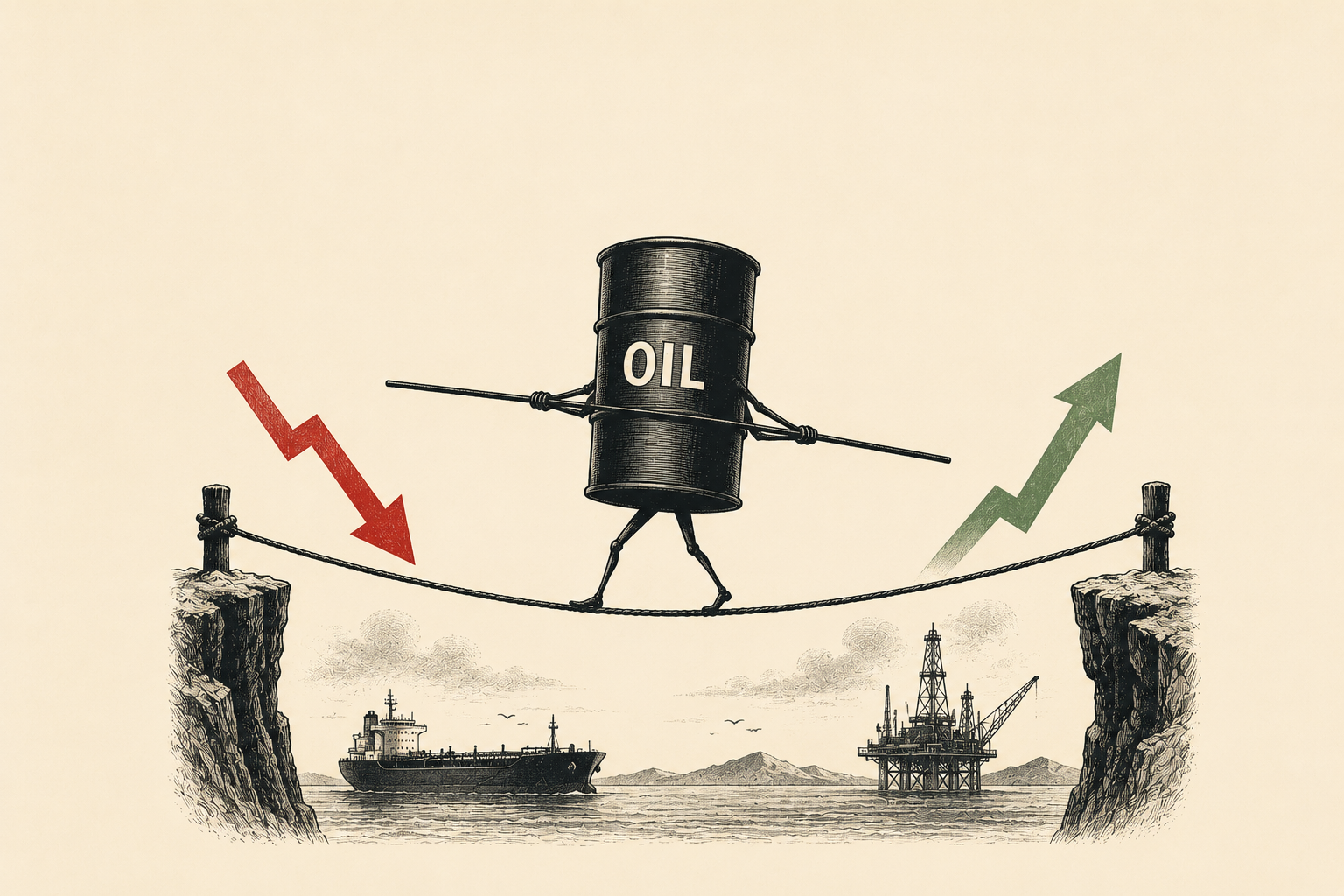
Why Oil Markets May Be Entering a New Era of Volatility
For much of the past decade, investors became accustomed to relatively predictable energy markets.
Oil prices moved in cycles, supply and demand generally remained balanced, and major disruptions were often temporary. While volatility never disappeared entirely, market participants could rely on a reasonably stable framework for evaluating future prices.
That environment is changing.
Today, oil markets face a combination of geopolitical uncertainty, shifting investment patterns, evolving energy policies, and changing demand dynamics. Together, these forces are creating conditions that could produce a more volatile market than many investors have experienced in recent years.
Understanding these changes is becoming increasingly important for governments, businesses, and investors alike.
A Market Facing Multiple Pressures
Oil markets have always been influenced by supply and demand.
However, modern energy markets are no longer driven solely by economic fundamentals.
Political decisions, sanctions, shipping disruptions, security concerns, and environmental policies now play a greater role than ever before.
This creates a market where prices can react rapidly to events that occur thousands of miles away from major consumers.
A disruption affecting production in one region may influence fuel prices globally within days.
As a result, oil markets have become more interconnected—and more sensitive.
Supply Growth Is Becoming Less Predictable
Historically, periods of high prices encouraged investment and production growth.
New projects would enter the market, supply would increase, and prices would eventually stabilize.
Today, that relationship has become less straightforward.
Many producers remain cautious after previous market downturns. Investors increasingly demand capital discipline rather than aggressive expansion.
At the same time, environmental pressures and energy-transition policies have complicated long-term investment decisions.
Energy companies must balance current demand with uncertainty about future consumption patterns.
This hesitation may limit supply growth and contribute to tighter market conditions during periods of strong demand.
Demand Remains More Resilient Than Expected
Despite widespread discussion about renewable energy and electrification, global oil demand has remained remarkably resilient.
Economic growth in emerging markets continues to support consumption.
Industrial activity, aviation, shipping, and transportation still rely heavily on petroleum products.
While efficiency improvements are reducing demand growth in some regions, overall global consumption remains substantial.
The result is a market where demand is not declining as quickly as some forecasts once suggested.
This dynamic increases the importance of supply stability.
Geopolitics Is Back at the Center of the Market
Perhaps the most important development is the growing influence of geopolitics.
Energy markets increasingly respond to:
- Regional conflicts
- Sanctions
- Security concerns
- Shipping disruptions
- Diplomatic tensions
Traders are no longer evaluating only production data and inventory levels.
They are also monitoring political developments, military activity, and strategic infrastructure.
The modern oil market has become as much a geopolitical market as an economic one.
This reality increases uncertainty and often amplifies price movements.
The Importance of Strategic Chokepoints
Global oil flows depend on a relatively small number of critical transportation routes.
When concerns emerge around major shipping corridors, markets pay attention immediately.
Even if physical supplies remain unaffected, the possibility of disruption can influence prices.
Risk premiums become embedded in market expectations.
This phenomenon demonstrates how transportation security has become an increasingly important component of energy pricing.
The value of a barrel of oil is influenced not only by production but also by the ability to deliver that barrel safely and efficiently.
What Investors Should Watch
Several indicators deserve close attention during the coming years:
- Global demand growth
- Production decisions by major exporters
- Investment levels across the energy sector
- Shipping activity
- Inventory trends
- Geopolitical developments
No single factor will determine future prices.
Instead, markets will continue responding to a combination of economic and political influences.
Investors who monitor both dimensions may be better positioned to understand emerging risks and opportunities.
The Long-Term Outlook
Oil’s role within the global economy is changing, but it remains significant.
Even as renewable energy expands, modern economies continue relying heavily on petroleum products.
The transition toward lower-carbon energy systems is underway, but it is likely to be gradual rather than immediate.
This suggests oil markets will remain highly relevant for years to come.
What may change is the nature of the market itself.
Instead of a relatively predictable environment, participants may need to adapt to a world where volatility becomes a permanent feature rather than an occasional event.
The Bottom Line
Oil markets are entering a period defined by complexity.
Traditional supply-and-demand analysis remains important, but it is no longer sufficient on its own.
Geopolitics, infrastructure security, investment trends, and energy-transition policies are becoming equally important drivers of market behavior.
For investors and businesses, the challenge is not simply predicting the next move in oil prices.
It is understanding the forces that are reshaping the market itself.
Those forces suggest that volatility may not be an exception in the years ahead—it may become the new normal.

