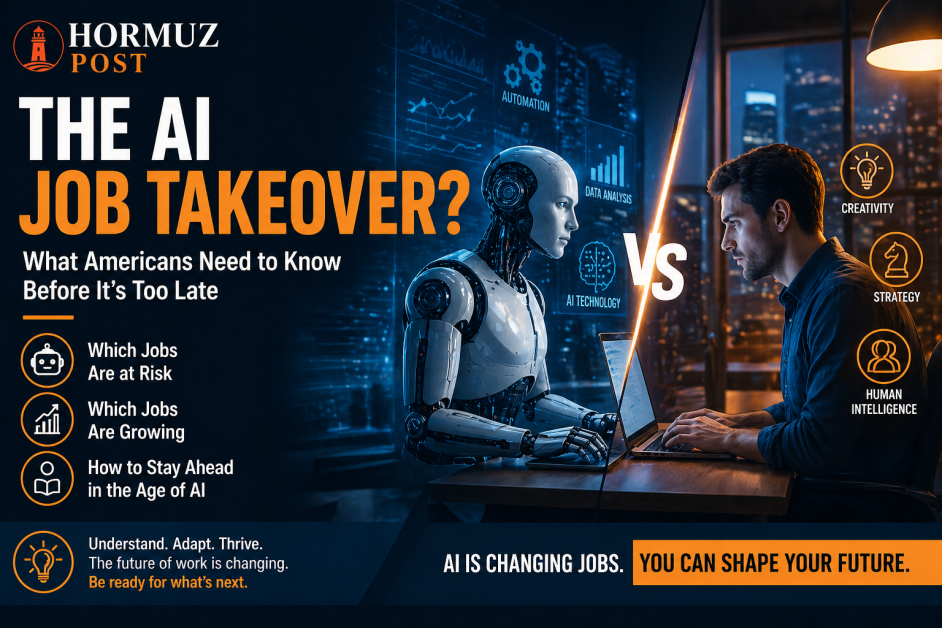
Introduction: Is AI Coming for Your Job?
It’s the question millions of Americans are quietly asking: Will AI take my job?
Artificial intelligence is advancing at a pace few expected. What started as a tool for automating simple tasks is now capable of writing content, analyzing data, designing graphics, and even making business decisions.
But the reality isn’t as simple as “AI replaces humans.” Instead, the workforce is undergoing a massive transformation—one that could redefine what it means to have a career in America.
The Jobs AI Is Already Replacing
AI is particularly effective at handling repetitive, predictable tasks. That’s why certain roles are already being reshaped or reduced.
1. Administrative and Data Entry Jobs
Tasks like scheduling, data input, and document processing are increasingly automated by AI systems. What once required hours of manual work can now be done in seconds.
2. Customer Support Roles
Chatbots and virtual assistants are now handling millions of customer inquiries daily. They can answer questions, process requests, and even resolve complaints—without human intervention.
3. Basic Content Creation
AI tools can generate articles, product descriptions, and marketing copy quickly and cheaply. While human creativity still matters, entry-level writing jobs are facing new competition.
The Jobs AI Is Creating
While some jobs are disappearing, others are emerging—often in areas that didn’t exist a decade ago.
1. AI Specialists and Engineers
Demand for AI experts is booming. Companies need professionals who can build, train, and maintain intelligent systems.
2. Data Analysts and Strategists
AI generates massive amounts of data, but humans are still needed to interpret it and make strategic decisions.
3. Creative and Human-Centered Roles
Jobs that require emotional intelligence, storytelling, and human connection—like marketing, design, and leadership—are becoming even more valuable.
The Hybrid Future: Humans + AI
The most realistic future isn’t AI replacing humans—it’s humans working alongside AI.
In many industries, AI acts as a “co-pilot,” helping workers:
- Write faster
- Analyze smarter
- Make better decisions
This hybrid model is already visible in offices across America. Employees who know how to use AI tools effectively are becoming more productive—and more valuable.
The Skills That Will Matter Most
As AI reshapes the job market, certain skills are becoming essential:
- Adaptability: The ability to learn and adjust quickly
- Digital literacy: Understanding how to use AI tools
- Critical thinking: Evaluating AI-generated outputs
- Creativity: Producing ideas AI cannot replicate
The workers who thrive will not be those who resist AI—but those who learn to use it.
The Risk: A Growing Skills Gap
One of the biggest challenges facing the U.S. workforce is the growing gap between current skills and future demands.
Many workers are not yet trained to work with AI systems. Without proper education and reskilling programs, this gap could lead to increased inequality and job displacement.
Governments, companies, and educational institutions will need to act quickly to prepare the workforce for this new reality.
What Americans Can Do Right Now
The rise of AI doesn’t have to be a threat—it can be an opportunity. Here’s how individuals can stay ahead:
- Learn AI tools: Familiarize yourself with platforms used in your industry
- Upgrade your skills: Focus on areas that AI can’t easily replace
- Stay informed: Follow trends in technology and the job market
- Be proactive: Don’t wait for change—anticipate it
The Bigger Picture: Economic Transformation
AI is not just changing individual jobs—it’s reshaping the entire U.S. economy.
Companies that adopt AI are becoming more efficient and competitive. Entire industries are evolving, and new business models are emerging.
At the same time, this transformation raises important questions about job security, income distribution, and the future of work.
It’s Not Too Late—But It’s Time to Act
AI is not a distant threat—it’s a present reality. The job market is changing, and those who adapt will have a significant advantage.
The key is not to fear AI, but to understand it.
Because in the age of artificial intelligence, the question isn’t “Will AI take your job?”
It’s “Are you ready to work with it?”

